Migrating to GTK3
Wednesday, December 17, 2025
Factor has a native ui-backend that allows us to render our UI framework using OpenGL on top of platform-specific APIs for our primary targets of Linux, macOS, and Windows.
On Linux, for a long time that has meant using the
GTK2 library, which has also meant using
X11 and an old library
called libgtkglext which provides a way to use OpenGL within GTK
windows. Well, Linux has moved on and is now pushing
Wayland as the “replacement for the X11
window system protocol and architecture with the aim to be easier to
develop, extend, and maintain”. Most modern Linux distributions have moved
to GTK3 or GTK4 and abstraction libraries like
libepoxy for working with OpenGL and
others for supporting both X11 and Wayland renderers.
I was reminded of this after our recent Factor 0.101 release when someone asked the question:
Does that message mean that Factor still relies on GTK2? IIRC it was EOL:ed around 2020.
Well, this is embarassing – yeah it sure does! Or rather – yes it sure did.
I got motivated to look into what it would take to support GTK3 or GTK4. We had a pull request that was working through adding support for GTK4. After merging that, and modifying it to also provide GTK3 support, I re-discovered that our OpenGL rendering was generally using OpenGL 1.x pipelines and that would not work in a GTK3+ world.
So, after adding OpenGL 3.x support for most of the things our user interface needs, and migrating from GTK 2.x to GTK3, we now have experimental nightly builds using the GTK3 backend:
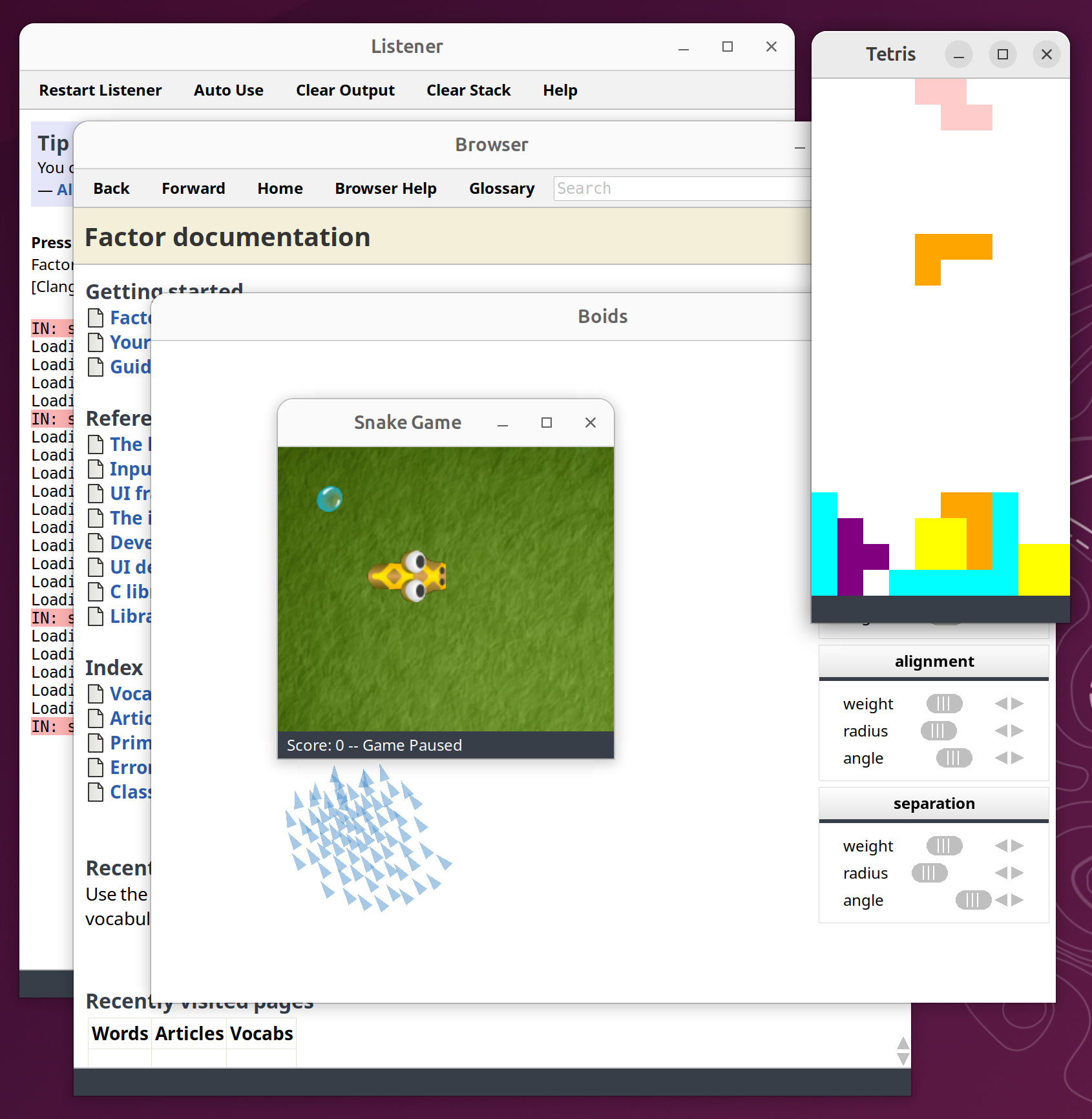
You can revert to the older GTK2 backend by applying this diff and then performing a fresh bootstrap:
diff --git a/basis/bootstrap/ui/ui.factor b/basis/bootstrap/ui/ui.factor
index 2974e530f9..416704ce29 100644
--- a/basis/bootstrap/ui/ui.factor
+++ b/basis/bootstrap/ui/ui.factor
@@ -12,6 +12,6 @@ IN: bootstrap.ui
     {
         { [ os macos? ] [ "ui.backend.cocoa" ] }
         { [ os windows? ] [ "ui.backend.windows" ] }
-        { [ os unix? ] [ "ui.backend.gtk3" ] }
+        { [ os unix? ] [ "ui.backend.gtk2" ] }
     } cond
 ] if* require
diff --git a/basis/opengl/gl/extensions/extensions.factor b/basis/opengl/gl/extensions/extensions.factor
index 2d408e93bb..51394eeb4a 100644
--- a/basis/opengl/gl/extensions/extensions.factor
+++ b/basis/opengl/gl/extensions/extensions.factor
@@ -7,7 +7,7 @@ ERROR: unknown-gl-platform ;
 << {
     { [ os windows? ] [ "opengl.gl.windows" ] }
     { [ os macos? ]  [ "opengl.gl.macos" ] }
-    { [ os unix? ] [ "opengl.gl.gtk3" ] }
+    { [ os unix? ] [ "opengl.gl.gtk2" ] }
     [ unknown-gl-platform ]
 } cond use-vocab >>
It seems like the newer OpenGL 3.x functions might introduce some lag which is visible when scrolling on some installations, perhaps by not caching certain things that were cached in the OpenGL 1.x code paths. There will need to be some improvements before we are ready to release it, but it is plenty usable as-is.
I also migrated our macOS backend to use the OpenGL 3.x functions as well to allow us to more broadly test and improve these new rendering paths.
This is available in the latest development version.